Skin cleansing products can look similar on the surface, but the way they are formulated and how they are intended to be used can vary considerably.
For professionals working in aesthetic and skincare settings, understanding those differences can make it easier to choose products that fit comfortably into everyday protocols.
One area attracting growing interest is hypochlorous acid, or HOCl. But how does an HOCl-based skin cleanser differ from more traditional cleansing options such as alcohol-based products or surfactant cleansers?
The Short Answer: How Is Hypochlorous Acid Different From Traditional Skin Cleansers?
Hypochlorous acid skincare products differ from traditional cleansers mainly in their formulation and intended use. HOCl products are often water-based and designed for simple, gentle cleansing, while traditional cleansers may rely on alcohol, surfactants, fragrance, or other ingredients. The most appropriate choice depends on the formulation, skin, setting, and intended cosmetic application.
What Is Hypochlorous Acid in Skincare?
Hypochlorous acid, commonly abbreviated to HOCl, can be incorporated into water-based cosmetic formulations designed to cleanse and refresh the skin.
As with any skincare ingredient, the name of the ingredient alone does not tell you everything about the finished product.
An HOCl spray may differ from another HOCl spray depending on:
How it is manufactured
Its pH
Its purity
Its stability
The amount of sodium hypochlorite present
Additional ingredients
Packaging and storage
Its intended cosmetic use
That is why it is more useful to evaluate a complete formulation rather than simply compare ingredient names.
What Do Traditional Skin Cleansers Use?
Traditional skin cleansers can be formulated in many different ways.
Depending on the product, they may contain:
Surfactants
Alcohol
Fragrance
Emollients
Foaming agents
Preservatives
Botanical ingredients
Other cosmetic ingredients
Many conventional facial cleansers are designed to lift oils, makeup, sunscreen, and surface debris from the skin before being rinsed away.
Other products, particularly those used in professional settings, may be designed to remain on the skin without rinsing.
The key difference is therefore not simply whether a product is "traditional" or "HOCl-based," but how the complete formulation fits its intended purpose.
Hypochlorous Acid vs Alcohol-Based Cleansers
Alcohol is widely used in personal care and professional-use products because it evaporates quickly and can create a lightweight, residue-free feel.
However, alcohol-based formulations may not be suitable for every cosmetic skincare routine.
For professionals working with skin that may already appear dry, sensitized, or uncomfortable, the sensory characteristics of a cleansing product can be important.
An alcohol-free HOCl skincare formulation may provide an alternative where a simple, water-based product is preferred.
This does not mean that one category is universally better than the other.
The right choice depends on:
The intended cosmetic use
The skin being cleansed
The treatment or skincare setting
The other products being used
The manufacturer's directions
Clinisept+ Skin is alcohol-free and fragrance-free and is designed for incorporation into professional and everyday cosmetic skin-cleansing routines.
Hypochlorous Acid vs Surfactant Cleansers
Surfactants are commonly used in facial cleansers because they help loosen oils, makeup, sunscreen, and other substances from the skin's surface.
These products are often used with water and rinsed away after cleansing.
This can make them particularly useful when the skin needs a more traditional wash-based cleanse.
An HOCl mist or spray can fit a different role.
Depending on the formulation and manufacturer instructions, an HOCl product may be used as a simple leave-on cleansing step without the need for the same wash-and-rinse process.
For professionals, this means the two product types should not necessarily be viewed as direct substitutes.
A surfactant cleanser may be helpful when makeup, oil, or visible surface debris needs to be removed, while an HOCl-based cosmetic cleanser may fit into a different stage of a professional skincare protocol.
Is Hypochlorous Acid the Same as a Facial Cleanser?
Not always.
"Facial cleanser" is a broad category.
Some cleansers are designed specifically to remove makeup, oil, sunscreen, and daily buildup. Others are lightweight cleansing mists or sprays designed to refresh and cleanse the skin without a traditional rinse-off step.
A hypochlorous acid skincare product can fall into the latter category depending on its formulation and intended use.
For this reason, professionals and consumers should follow the individual product instructions rather than assuming every cleanser should be used in the same way.
What About Chlorhexidine?
Chlorhexidine is sometimes encountered in professional healthcare environments, but it occupies a very different product and regulatory context from cosmetic HOCl skincare.
Products containing chlorhexidine may be regulated and used for purposes that go beyond cosmetic cleansing.
For a cosmetic skincare brand such as Clinisept+, it is important not to treat chlorhexidine products and cosmetic HOCl formulations as interchangeable categories.
For practitioners, the practical takeaway is simple: always choose a product based on its labeled intended use, regulatory positioning, and manufacturer instructions.
Does an HOCl Spray Need to Be Rinsed Off?
This depends on the individual product.
Some cleansers are designed to be washed away, while others are formulated to remain on the skin.
Clinisept+ Skin is designed to be easy to incorporate into cosmetic cleansing routines without adding unnecessary complexity to the protocol.
For professionals, this can be useful when choosing products intended to integrate into busy treatment environments.
However, directions for use should always be followed exactly as provided for the individual product.
Why Does Residue Matter in Professional Skincare?
Product residue can affect how a skincare routine feels and how subsequent cosmetic products are applied.
This can be especially relevant in professional aesthetic settings where several products may be used in succession.
When choosing a cleanser, professionals may therefore want to consider:
Whether rinsing is required
Whether the product leaves a noticeable film
How easily it integrates with the next step in the protocol
Whether fragrance or other sensory ingredients are present
Whether the product is designed for repeated cosmetic use
A simple formulation can help reduce unnecessary steps and make protocols easier for teams to follow consistently.
How Does Hypochlorous Acid Fit Into Professional Aesthetic Skincare?
In professional aesthetic environments, skin cleansing is rarely a standalone task.
It often forms part of a wider protocol that includes preparation, treatment, and aftercare.
An HOCl-based skin cleanser may be useful where professionals are looking for:
A straightforward cosmetic cleansing step
An alcohol-free option
A fragrance-free formulation
A product that is easy to incorporate into existing protocols
A mist or spray format
A simple option for clients to continue using at home
The appropriate use will depend on the treatment setting, practitioner protocol, and product labeling.
What Should Professionals Compare When Choosing a Skin Cleanser?
Rather than focusing on one ingredient, practitioners should consider the complete product.
Useful questions include:
What is the cleanser designed to do?
Is it intended to remove makeup and oil, provide a lightweight cleansing step, or support a broader cosmetic skincare routine?
Does it need to be rinsed off?
This can affect both treatment-room practicality and client instructions.
Does it contain alcohol or fragrance?
For some practices and skincare routines, an alcohol-free and fragrance-free option may be preferred.
How complex is the formulation?
A simple formulation may be easier to integrate into a wide variety of professional skincare routines.
How is it packaged?
Professional formats, spray delivery, bottle size, and take-home options can all affect practical use.
Does the labelling match how you intend to use it?
The intended cosmetic application should always be consistent with the manufacturer's directions and product positioning.
HOCl vs Traditional Cleansers: A Simple Comparison
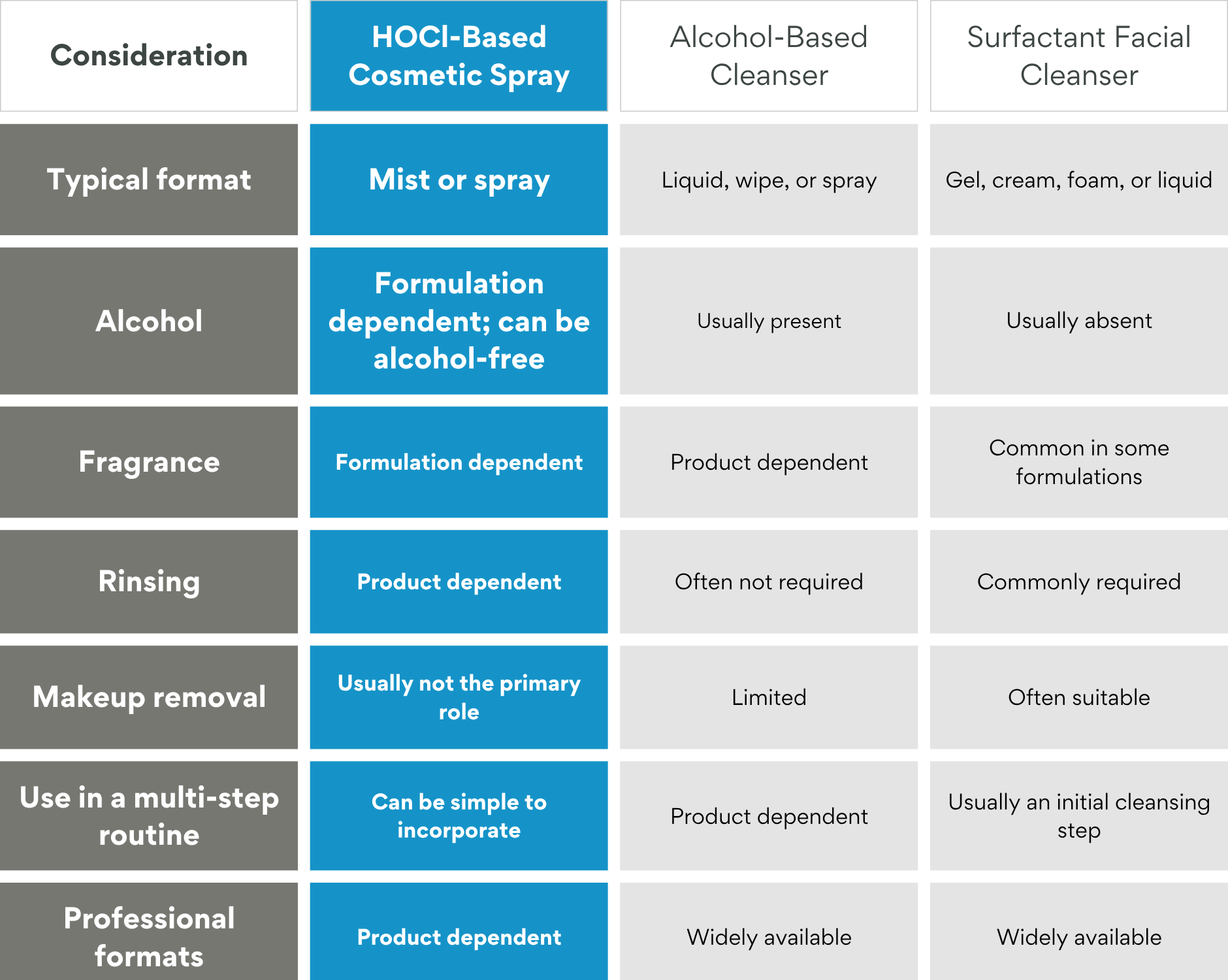
This comparison should be used as a general guide rather than a substitute for reviewing the individual product's formulation and directions.
Why Formulation Matters More Than Categories
It can be tempting to ask whether HOCl is "better" than a traditional cleanser.
That question is usually too broad to be useful.
Different products are designed for different purposes.
A wash-off facial cleanser may be the right choice when makeup and sunscreen need to be removed. An alcohol-based product may suit a particular professional protocol. An HOCl-based spray may be selected where a simple, alcohol-free, fragrance-free cosmetic cleansing step is preferred.
The more useful comparison is:
Which formulation is most appropriate for this particular cosmetic skincare application?
That approach allows professionals to make decisions based on actual product characteristics rather than ingredient trends.
Where Does Clinisept+ Skin Fit?
Clinisept+ Skin is formulated as a professional and everyday cosmetic skin cleanser.
It uses a proprietary manufacturing process rather than conventional electrolysis and is designed to provide a highly purified, stable hypochlorous formulation with low levels of sodium hypochlorite.
The formulation is:
Alcohol-free
Fragrance-free
Designed for straightforward cosmetic cleansing
Available in formats suitable for professional and home use
Created to integrate easily into skincare routines
This makes Clinisept+ Skin particularly relevant for professionals looking for a simple HOCl-based option within cosmetic skin hygiene protocols.
Can HOCl and a Traditional Facial Cleanser Be Used in the Same Routine?
Potentially, yes.
The two products can serve different cosmetic functions.
For example, a traditional wash-off cleanser may be used first to remove makeup, sunscreen, oils, or visible debris. An appropriately formulated HOCl skincare product may then fit into another step of the routine according to its directions for use.
There does not always need to be an "either/or" decision.
The most appropriate routine depends on the person's skin, products being used, and the professional protocol being followed.
Is Hypochlorous Acid Suitable for Sensitive Skin Routines?
Suitability depends on the finished formulation rather than the ingredient name alone.
When choosing products for sensitive skin routines, consumers and professionals may prefer to look for characteristics such as:
Alcohol-free formulations
Fragrance-free formulations
Simple ingredient lists
Products designed specifically for cosmetic skin use
Clear directions for use
Clinisept+ Skin is formulated without alcohol or fragrance and is designed for gentle cosmetic cleansing.
As with any skincare product, individual responses can vary.
Frequently Asked Questions
Is hypochlorous acid a cleanser?
HOCl can be incorporated into cosmetic products designed to cleanse and refresh the skin. The role of an individual product depends on its full formulation and intended use.
Is HOCl the same as a face wash?
Not necessarily. Many face washes use surfactants and water to remove oil, makeup, and sunscreen and are then rinsed away. HOCl skincare products are often supplied as sprays or mists and may be used differently.
Does HOCl replace my normal cleanser?
That depends on what you need your cleanser to do. If you are removing makeup, sunscreen, or significant surface buildup, a conventional facial cleanser may still form an important part of the routine.
What should I look for in an HOCl skincare product?
Look at manufacturing method, purity, stability, pH, supporting ingredients, alcohol and fragrance content, packaging, storage instructions, and intended cosmetic use.
The Bottom Line
Hypochlorous acid skincare products and traditional skin cleansers are not necessarily competing products.
They can play different roles within a cosmetic skincare routine.
Traditional cleansers may be particularly useful for removing makeup, oil, sunscreen, and visible buildup, while a well-formulated HOCl spray can offer a simple, lightweight cleansing step that may be convenient in both professional and everyday skincare settings.
For practitioners, the most important consideration is not whether a product belongs to one category or another. It is whether the finished formulation is appropriate for the intended cosmetic use and integrates effectively into the wider skincare protocol.